
english
الشريط الجانبي للمقالة
محتوى المقالة الرئيسي
الملخص
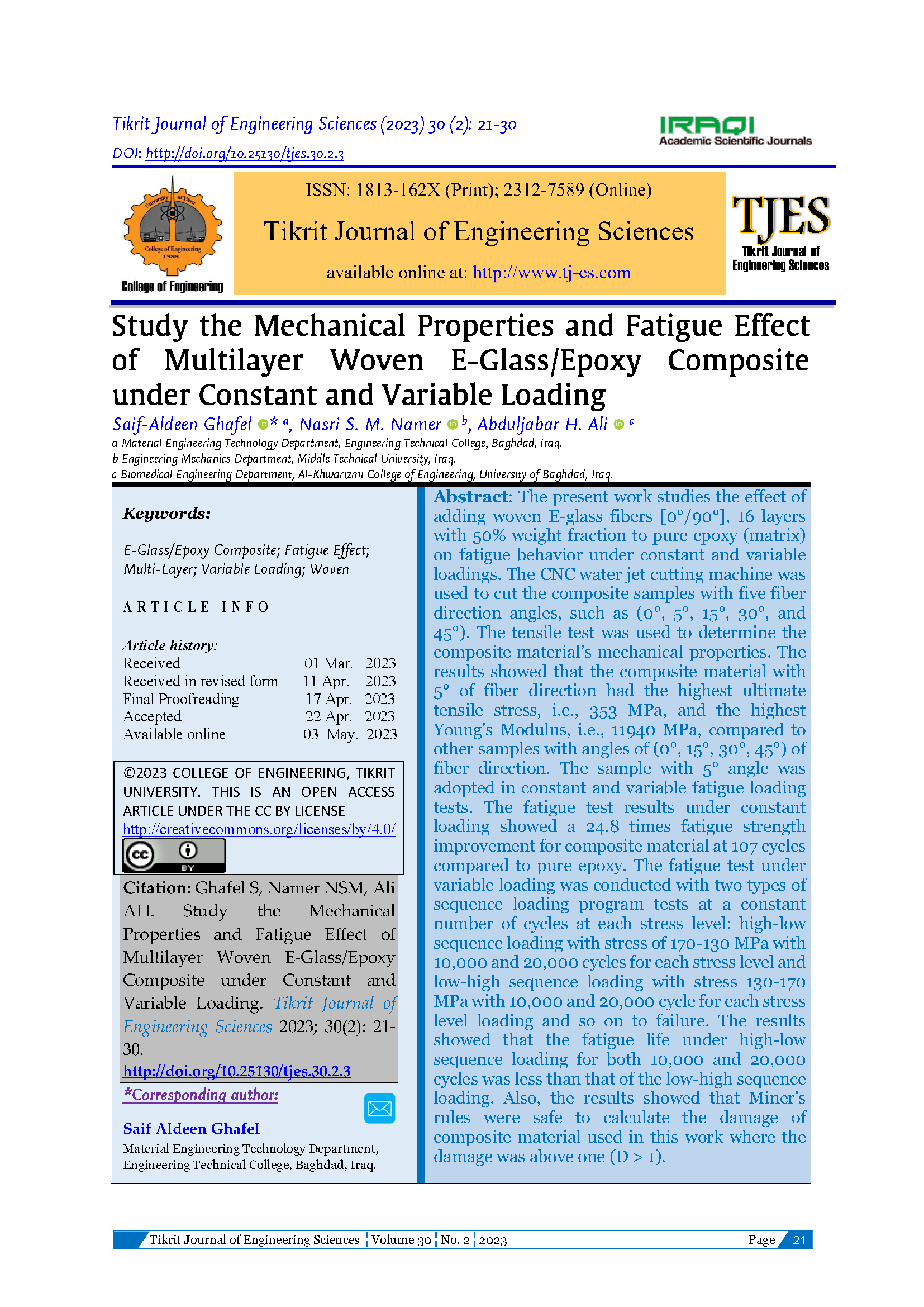
يدرس العمل الحالي تأثير إضافة ألياف زجاجية منسوجة بدرجة [0° / 90°]، 16 طبقة كسر وزني 50٪ إلى إيبوكسي نقي (مصفوفة) على سلوك الكلال تحت حمل ثابت وحمل متغير. تم استخدام آلة القطع بنفث الماء CNC لقطع العينات المركبة بخمس زوايا لاتجاه الألياف [0° ، 5° ، 15° ، 30° ، 45°]. استخدم اختبار الشد لتحديد الخواص الميكانيكية للمادة المركبة. أظهرت النتائج أن المادة المركبة ذات اتجاه الألياف [5°] لديها أعلى إجهاد شد نهائي 353 ميكا باسكال وأعلى معامل يونغ 1194 ميكا باسكال مقارنة بالعينات الأخرى ذات الزوايا [0° ، 15° ، 30° ، 45°] لاتجاه الألياف. تم اعتماد العينة بزاوية [5o ] في اختبار تحميل الكلال عند اجهاد ثابت واجهاد متغير. أظهرت النتائج في اختبار الكلال تحت الحمل الثابت تحسن في مقاومة الكلال للمواد المركبة عند 107 دورات (24.8 مرة) مقارنة مع الايبوكسي النقي. تم إجراء اختبار الكلال تحت حمل متغير باستخدام برنامج اختبار تحميل متسلسل من النوعين: مع عدد ثابت من الدورات عند كل مستوى إجهاد، تحميل متسلسل مرتفع - منخفض مع اجهاد 170-130 ميكا باسكال مع 10000 و 20000 دورة لكل مستوى إجهاد، وحمل منخفض - مرتفع متسلسل مع اجهاد 130-170 ميكا باسكال مع 10000 و 20000 دورة لكل تحميل مستوى اجهاد وهكذا إلى الفشل. أظهرت النتائج أن حياة الكلال في ظل التحميل المتسلسل المرتفع – المنخفض لكل من 10000 و 20000 دورة كان أقل من التحميل المتسلسل المنخفض – المرتفع. أظهرت النتائج أيضًا أن قاعدة ما ينر أعلى من (1 > D) لحساب تحطم المركب كانت آمنة الاستخدام.
تفاصيل المقالة
القسم

هذا العمل مرخص بموجب Creative Commons Attribution 4.0 International License.
THIS IS AN OPEN ACCESS ARTICLE UNDER THE CC BY LICENSE http://creativecommons.org/licenses/by/4.0/
كيفية الاقتباس


المراجع
Vassilopoulos A. Introduction to the fatigue life prediction of composite materials and structures: past, present and future prospects, in Fatigue life prediction of composites and composite structures. 2010, Elsevier.
Halford G, R. Fatigue and durability of structural materials. 2006, Asm International.
Alalkawi H, Khenyab A, Y, K, and Ali A, H. Improvement of Mechanical and Fatigue Properties for Aluminum Alloy 7049 by using Nano Composites Technique. Al-Khwarizmi Engineering Journal 2019; 15(1): 1-9.
Frost N, Marsh K, and Pook L. Metal fatigue. 1974, Oxford ED; Clarendon.
Harris B. Fatigue in composites: science and technology of the fatigue response of fibre-reinforced plastics. 2003, Woodhead Publishing.
Talreja R. Fatigue of Composite Materials: Damage Mechanisms and Fatigue-Life Diagrams. Proceedings of the Royal Society of London. A. Mathematical and Physical Sciences 1981; 378(1775): 461-475.
Mousavi Khorasani M, A, Sahebian S, and Zabett A. Effects of Toughened Polyester on Fatigue Behavior of Glass Fiber Reinforced Polyester Composite for Wind Turbine Blade. Polymer Composites 2021; 42(1): 70-82.
Curtis P. The Fatigue Behaviour of Fibrous Composite Materials. The Journal of Strain Analysis for Engineering Design 1989; 24(4): 235-244.
Laseure N, Schepens I, Micone N, and De Waele W. Effects of Variable Amplitude Loading on Fatigue Life. International Journal of Sustainable Construction and Design 2015; 6(3):1-10.
Degrieck J,and Van Paepegem W. Fatigue Damage Modeling of Fibre-Reinforced Composite Materials. Applied Mechanics Reviews 2001; 54(4): 279-300.
Rice RC. Fatigue design handbook (Vol. 10). Society of Automotive Engineers 1988.
Taşdemir B. Fatigue and static behavior of curved composite laminates. Master's thesis; 2018, Middle East Technical University.
Lamon F, Maragoni L, Carraro P, and Quaresimin M. Fatigue Damage Evolution in Woven Composites with Different Architectures. International Journal of Fatigue 2023; 167: 107365.
Mahboob Z, Fawaz Z, and Bougherara H. Fatigue Behaviour and Damage Mechanisms under Strain Controlled Cycling: Comparison of Flax-Epoxy and Glass-Epoxy Composites. Composites Part A: Applied Science and Manufacturing 2022, 107008.
Liu C, Wu X, and Gao X. Comparisons of Tension–Tension Fatigue Behavior between the 3D Orthogonal Woven and Biaxial Warp-Knitted Composites. The Journal of The Textile Institute 2021; 112 (8): 1249-1257.
Khalifah K, M. Effect of Nano Clay on the Fatigue of Epoxy and Glass Fiber Composites. Journal of Physics: Conference Series 2021; 1829 (1): 012011.
Venkatesha B, Kumar S, P, Saravanan R, and Ishak A. Tension Fatigue Behaviour of Woven Bamboo and Glass Fiber Reinforced Epoxy Hybrid Composites. in IOP Conference Series: Materials Science and Engineering 2020; 1003 (1): 012087. IOP Publishing.
Broer A. Fatigue life prediction of carbon fibre-reinforced epoxy laminates using a single SN curve. M.Sc. Thesis; 2018, Delft University of Technology.
Roundi W, El Mahi A, El Gharad A, and Rebière J, L. Experimental and Numerical Investigation of the Effects of Stacking Sequence and Stress Ratio on Fatigue Damage of Glass/Epoxy Composites. Composites Part B: Engineering 2017; 109: 64-71.
Mostafa N, H, Ismarrubie Z, Sapuan S, and Sultan M. Effect of Fabric Biaxial Prestress on the Fatigue of Woven E-Glass/Polyester Composites. Materials & Design 2016; 92: 579-589.
Mahltig B, and Kyosev Y. Inorganic and composite fibers: production, properties, and applications. 2018.
Sathishkumar T, Satheeshkumar S, and Naveen J. Glass Fiber-Reinforced Polymer Composites–A Review. Journal of Reinforced Plastics and Composites 2014; 33 (13): 1258-1275.
Al-alkawi J, H, Al-Fattal S, D, and Ali H, A, J. Fatigue Behavior of Woven Glass Fiber Reinforced Polyester under Variable Temperature. Elixir Mechanical Engineering 2012; 53: 12045-12050.
Miner, M. A. (March 9, 2021). Cumulative Damage in Fatigue. ASME. Journal of Applied Mechanics 1945; 12(3): A159–A164. https://doi.org/10.1115/1.4009458.